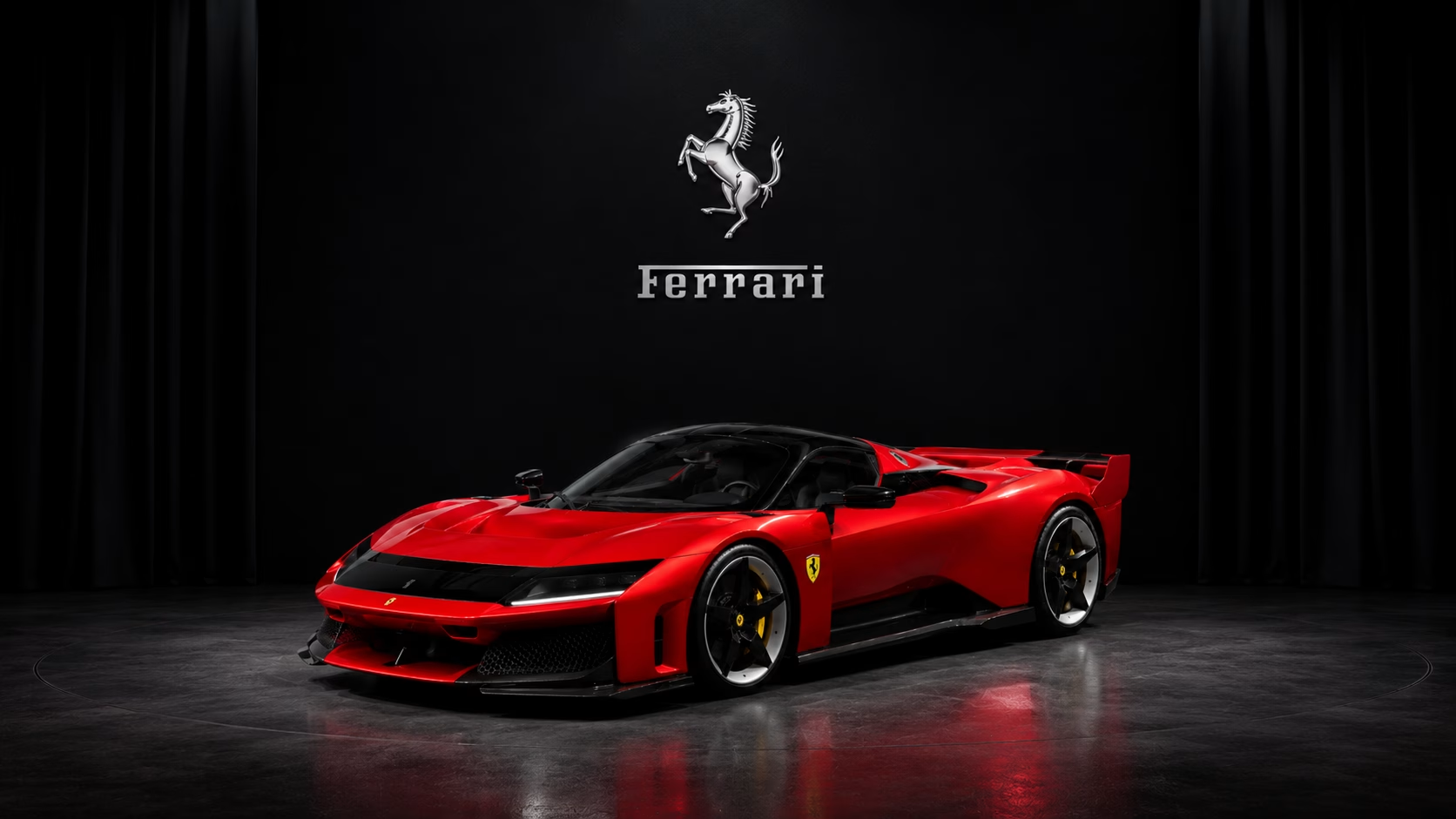
The Ferrari F80 is not understood as an isolated launch, but as the direct consequence of a philosophy Ferrari has upheld since Enzo Ferrari: the road is always the translation of the track. Over decades, each of the brand’s hypercars has acted as the technological summary of its era, and the F80 assumes that role in an age defined by energy efficiency and extreme aerodynamics.
Design as Explanation, Not Illusion
Its design does not try to look fast; it tries to explain why it is fast. The body stops being mass and becomes flow — excavated surfaces, channels crossing the vehicle, and a visually suspended cockpit reveal how air enters, compresses, and releases. Ferrari returns to its historical principle: when function is pushed to its limit, it inevitably becomes aesthetic. The F80 does not seek classical beauty but physical coherence, as if sculpted by invisible forces rather than human hands.
«When function is pushed to its limit, it inevitably becomes aesthetic. The F80 does not seek classical beauty but physical coherence — as if sculpted by invisible forces rather than human hands.»
Electrification as Amplifier, Not Replacement
Technically, the F80 represents the brand’s most radical step toward electrification, yet its innovation lies not only in combining combustion and electric power, but in how that technology communicates with the driver. Ferrari avoids the contemporary tendency to isolate the user within a silent, perfected experience; instead, electronics intensify perception. Assistance does not replace skill — it amplifies it. The driver feels weight transfer, grip, and immediate response as part of a continuous dialogue with the machine.
The hybrid system adds power and precision, but also emotional continuity: acceleration is not only faster, it’s more readable. In an industry turning the automobile into an interface, Ferrari insists on keeping it an instrument. The F80 does not aim to domesticate speed, but to make it understandable — proving the future can be advanced without becoming impersonal, and that innovation, rather than erasing character, can give it new ways to exist.
The F80, By the Numbers
- Powertrain: 3.0-liter twin-turbo V6, derived directly from the Le Mans-winning 499P endurance racer, paired with three electric motors.
- Output: Nearly 1,200 combined horsepower — the most powerful road car Ferrari has ever built.
- Acceleration: 0–62 mph in 2.15 seconds; 0–124 mph in 5.75 seconds.
- Top speed: 350 km/h (218 mph).
- Downforce: Over 2,200 lbs at 155 mph, generated through active aerodynamics and a 48V active suspension system.
- Exclusivity: Limited to 799 units, all allocated before the car’s public reveal in October 2024, with pricing starting near $3.9 million.
Succeeding the LaFerrari as the sixth car in Ferrari’s halo lineage — after the 288 GTO, F40, F50, Enzo, and LaFerrari — the F80 breaks from tradition in one striking way: it is the first of these hypercars not built around a V12. In its place, a six-cylinder engine outproduces every halo car that came before it, a decision Ferrari has defended as the price of true aerodynamic efficiency at the top of its range.
The result is a car that does not ask to be admired from a distance. It asks to be understood — proof that at Maranello, the future of performance is not measured only in horsepower, but in how honestly that power speaks to the person behind the wheel.